

257 Years: How Southern California Lost and Found Its Wine
A series in many parts. It begins with a draft card, two great-grandfathers, and a vine older than the United States.

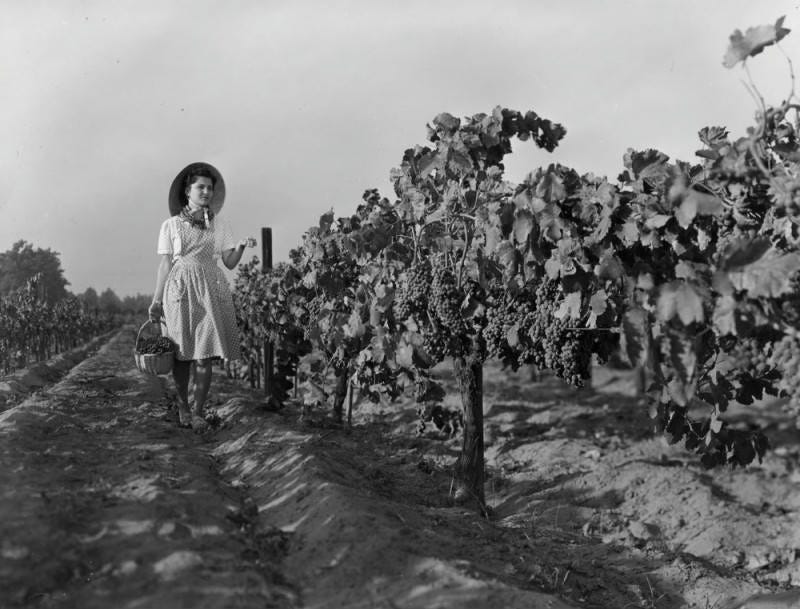
Los Angeles was once the wine capital of California. There were eighty wineries in Cucamonga alone. At one point, more vineyard acreage grew here than in Sonoma and Napa combined. A label called Pride of Cucamonga sold in New York, Philadelphia, Chicago, and Boston — until, over time, it disappeared.
I didn’t know any of that the morning I found the draft card.
I was fiddling with my phone, following the thread that comes from always thinking about wine — not just the drinking of it, but its history, its ritual, the land, and the people who worked it. I went looking for ancestors who might have worked in the industry. I already knew about my Bavarian great-great-grandfathers, vine-dressers in the old country. I went looking for more.
And I found them.
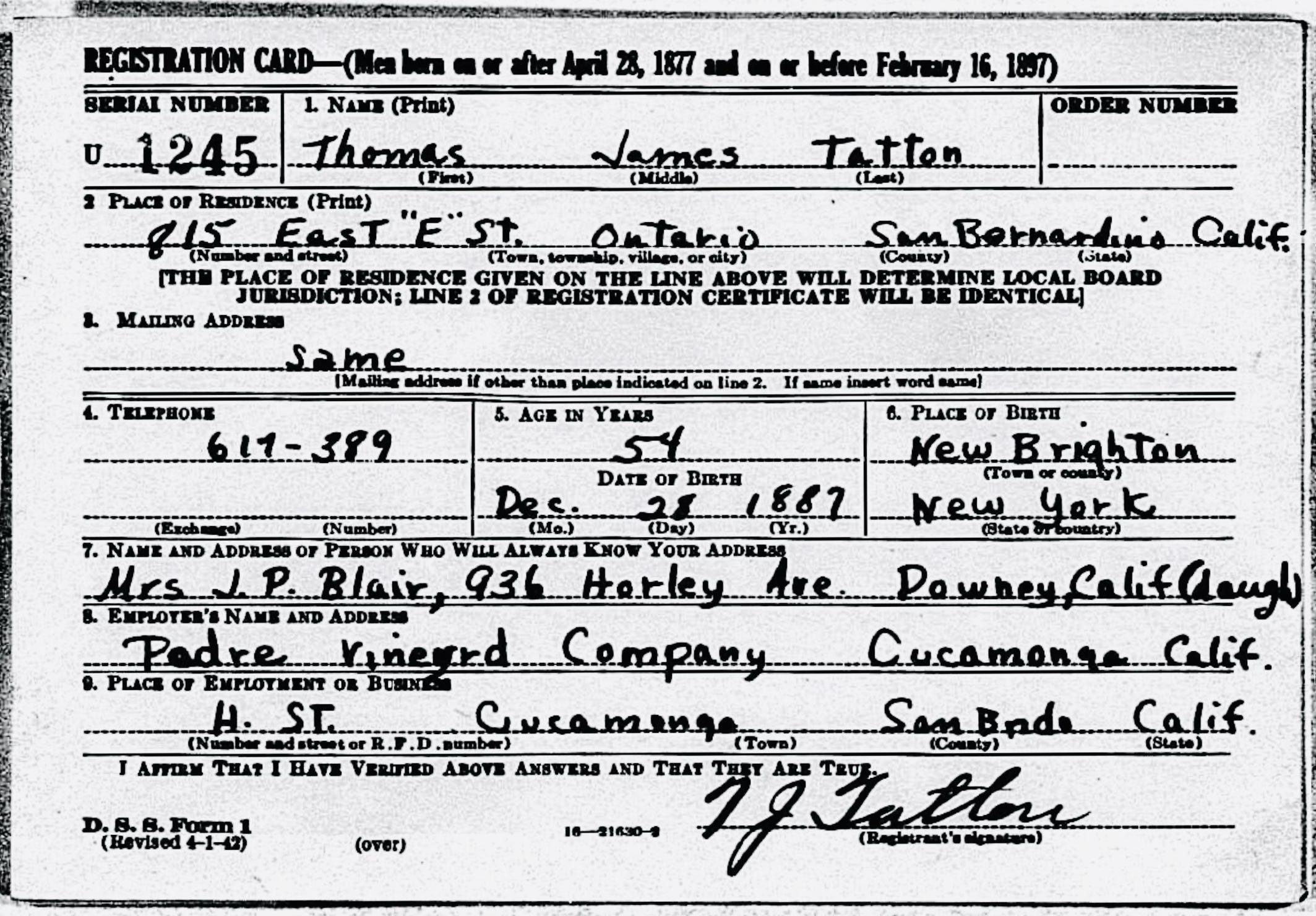
Thomas James Tatton. Carpenter. Ontario, California. Employer: Padre Vineyard Company, Cucamonga, 1942.
I sat with that for a while.
Then I looked at his emergency contact — the person the government asked him to name in the event of a war. Mrs. J.P. Blair. 936 Horley Avenue, Downey, California. His daughter. Which means John Philip Blair, my other great-grandfather, was working in the same industry, in the same region, at the same time. Two great-grandfathers. Family connected by blood and by the vine.
I remember seeing oranges stretch for miles; that’s what Southern California once represented, renowned worldwide. Now, those oranges are mostly gone, and the groves have moved to Central Valley farmland and agricultural areas. Like the vines before them, they were displaced by the same forces: growth, development, and relentless land economics that always place more value on the ground than on what grows from it.
The vines came first. Oranges replaced them. Houses and freeways replaced the oranges. Each generation buries something the previous one built.
This is a story about what survives anyway.
I knew little about Southern California wine when I found these documents. I knew Temecula. That Napa dominated. The desert where I live is hotter now; open land is vanishing. That sense of loss led me to look back at what used to grow here, and why it stopped.
What I found was a story that starts in 1769 and isn’t finished yet.
The City of Angels — I have witnessed this era. But the City of Vines remains new to me. Los Angeles was once the original wine capital of California: there were eighty wineries in Cucamonga alone. At one time, there was more vineyard acreage here than in Sonoma and Napa combined. A label called Pride of Cucamonga sold in New York, Philadelphia, Chicago, and Boston — until, over time, it disappeared.
It’s documented. The census records exist. The draft cards exist. The bonded winery licenses and the family names and the newspaper reviews calling Cucamonga wine “as fine an article as manufactured in the world” — all of it is there, if you look.
Which means people know and forget. Or only those in the industry remember. Or we are all so trained to look north for California wine that we stopped looking at what was right under our feet.
I've been a little undone by it ever since.
This series is my attempt to uncover and understand the lost and reviving legacy of Southern California wine — what was built, what was buried, and what is now coming back.
It is not a straightforward history. It’s a personal excavation with a bottle of wine open on the table. And it will take a while.
I hope you’ll stay.

What This Series Covers
Over the coming months, The Vine will follow the full arc of Southern California’s wine story — starting even before 1769 and before California itself, reaching back to Spain and Mexico. The narrative will move chronologically, showing the vine’s journey across two oceans and a continent before arriving in San Diego, which sets the historical stage for everything that follows.
Along the way, there will be field reports from wineries and AVAs. We’ll dig into the labor history that made all of this possible — and that most wine writing skips. Expect my great-grandfather’s draft card, a vine still alive at the San Gabriel Mission that’s older than the United States, and a question about what Southern California wine could become if the land survives long enough to find out.
Here is the rough shape of where we’re going:
Spain, Mexico, and the Vine That Crossed an Ocean: Before 1769, the Mission grape had already traveled from Castilla-La Mancha to the Canary Islands to Mexico. It arrived in California carrying 250 years of colonial history in its roots. That story deserves its own telling.
The City of Vines: Los Angeles is the original wine capital. The missionaries, the Mission grape, the boom, the diverse labor that built it all — the Indigenous workers, the Chinese immigrants, the Mexican and Yaqui laborers whose names are not on the wineries. The collapse no one fully talks about.
What the Freeway Buried: The Cucamonga district. Secondo Guasti, standing at the foot of the San Gabriel Mountains, watching floodwater, said, “Surely this is heaven’s doorstep.” Thomas Tatton, still showing up for work at the Padre Vineyard Company in 1942, the winery that held California Bonded License No. 1.
The Long Silence: Prohibition. Then came a brief, beautiful comeback, the “Pride of Cucamonga,” selling in a dozen American cities. But after that, the second collapse arrived, quieter and more permanent, as the freeways came, land values rose, and the vineyard families sold one by one.
Temecula is Fighting: The reincarnation. Heat-adapted grapes. Alicante Bouschet — Garnacha Tintorera in Spain, where it grows today in Castilla-La Mancha, the same region from which the Mission grape came. The sign on Rancho California Road that says Wine Country and means it.
Baja is Coming: The Valle de Guadalupe. What Mexico is building just south of the border, while Southern California rebuilds.
The Desert Wakes Up: The Coachella Valley. The South Coast AVA. The 2028 Olympics on the horizon. And a question I keep asking: if Castilla-La Mancha can grow serious wine in that heat and dryness, why not here? Anyone with me?
What We Owe the Vine: Land. Sustainability. What we lose when the open space disappears. What Southern California wine could become if we let it.

One Thing Before We Begin
The California wine industry was not built by pioneers in the romantic sense.
It was built by Indigenous people working under the mission system — planting, pruning, harvesting grapes, they were largely forbidden from drinking. It was built by Chinese immigrant laborers who dug wine caves by hand and cleared land for farming. By Mexican and Yaqui workers. By Italian immigrant families who arrived with nothing and built wine empires in a valley that looked, to everyone else, like desert.
The story of Southern California wine is more diverse, more multiethnic, and more working-class than most people realize. That history deserves to be in this series, not as a footnote, but as the foundation. We’ll go deeper into it as we go. But I wanted you to know it’s here from the start.

Where We Begin: 1769
The first planting of the Mission grape in California was done by Junipero Serra at Mission San Diego de Alcalá in 1769. The next vines were planted at Mission San Gabriel Arcángel in 1771 — a mission designed by Father Antonio Cruzado, born in Córdoba, Spain, whose Moorish architecture was directly inspired by the famous cathedral of Córdoba. The cuttings from San Gabriel were eventually used to start new plantings at Pueblo de Los Ángeles around 1786.
Mission San Gabriel became the wine mission. At its peak, it produced 9,000 gallons of wine and 3,000 gallons of brandy annually. It supplied other missions across California with the necessities of life. It was called the Pride of the Missions.
The vine that grew there is still alive.
Known as the Ramona Vine, it is one of the oldest cultivated grapevines in California — its exact age debated, its survival undeniable. It is technically a hybrid — a cross of the Mission grape brought over by Serra and the Southern California native grape, Vitis girdiana. Something that exists only here, from the meeting of an imported vine and California’s own soil. The trunk is now the size of a gnarled old tree, its branches stretching 24 inches thick along the mission pergola. Only six vines of this type are known to exist in the world.
In 2020, a group of Los Angeles winemakers harvested grapes from it and made wine for the first time in more than two centuries. Using techniques dating back to the mission era, they produced a half barrel of Angelica — the fortified dessert wine that historians consider the first true California wine. The wine tasted, one of them said, like cherry cordial. Unique in the world.
That vine survived two earthquakes and a fire that destroyed the mission’s roof. It survived Prohibition. It survived the decades when everyone forgot that Southern California ever made wine at all.
It is still there.
In a place most people drive past without knowing what they’re looking at.
That’s where this story begins. And in some ways, it’s also where it ends — with something old and stubborn and alive, producing fruit nobody expected.
The vine remembers what the freeway buried.

Next in the series: Spain, Mexico, and the vine that crossed an ocean — the origin story before the origin story. Coming next month.

The Ledger Entry
If someone in your family worked these vineyards, lived in these towns, made something from this land — I'd love to hear about it. Names, towns, the smallest detail. The vine remembers more than we do.
— Jen.